Series of co-creation
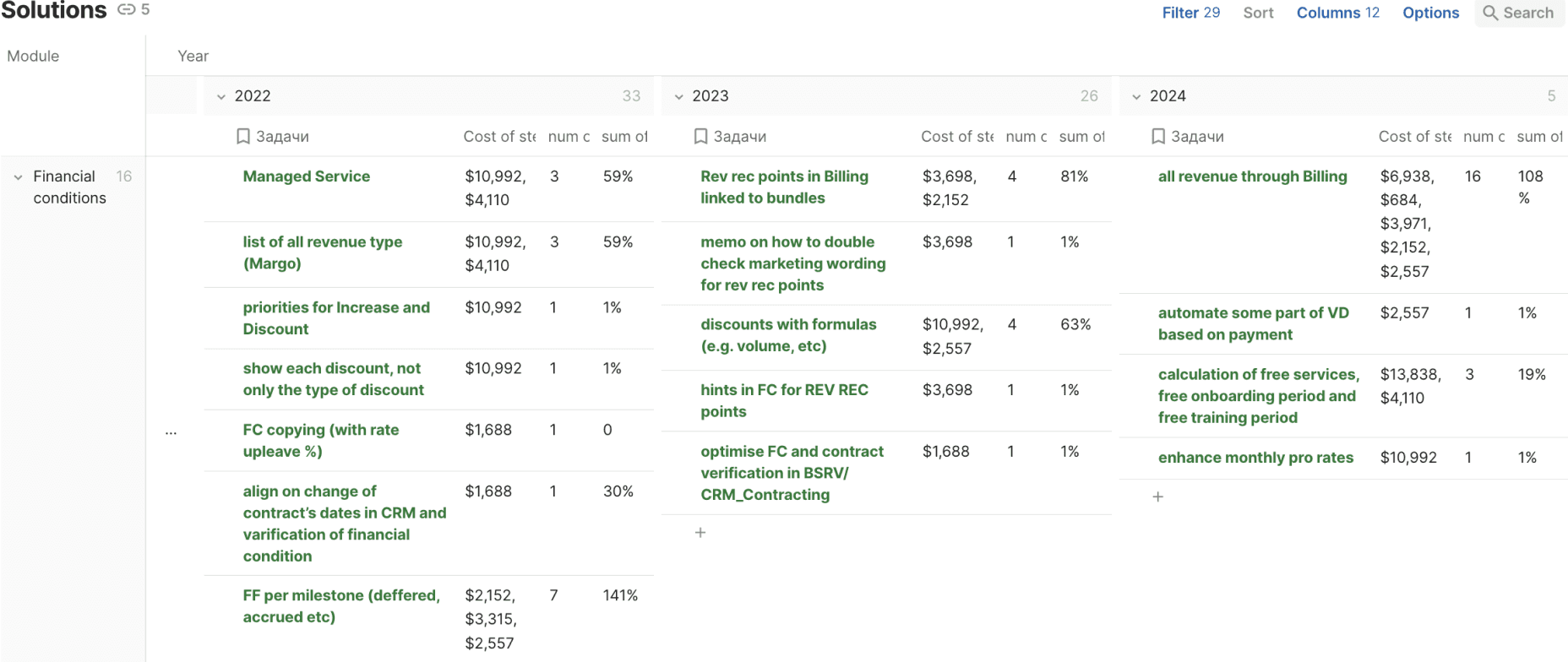
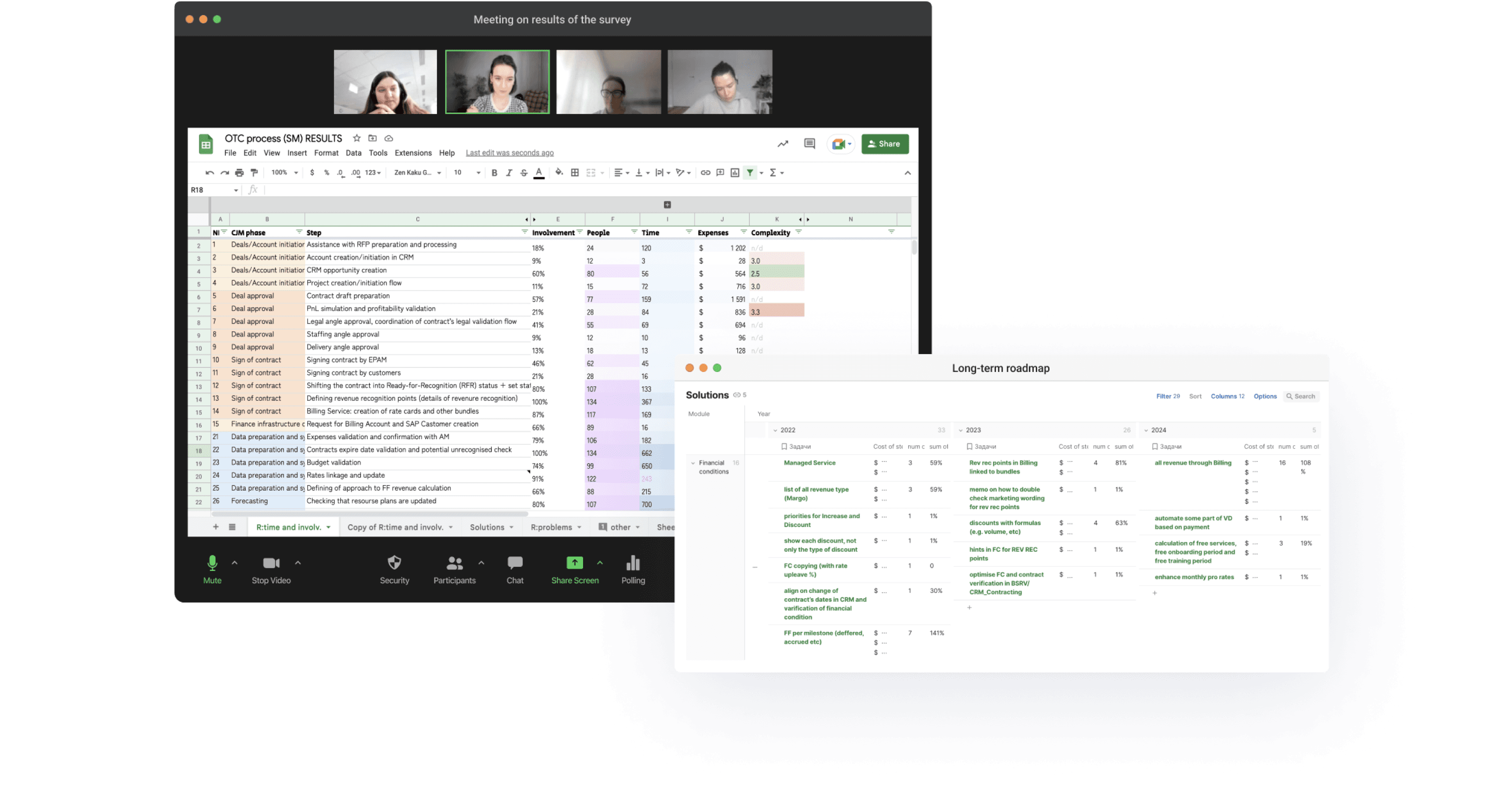
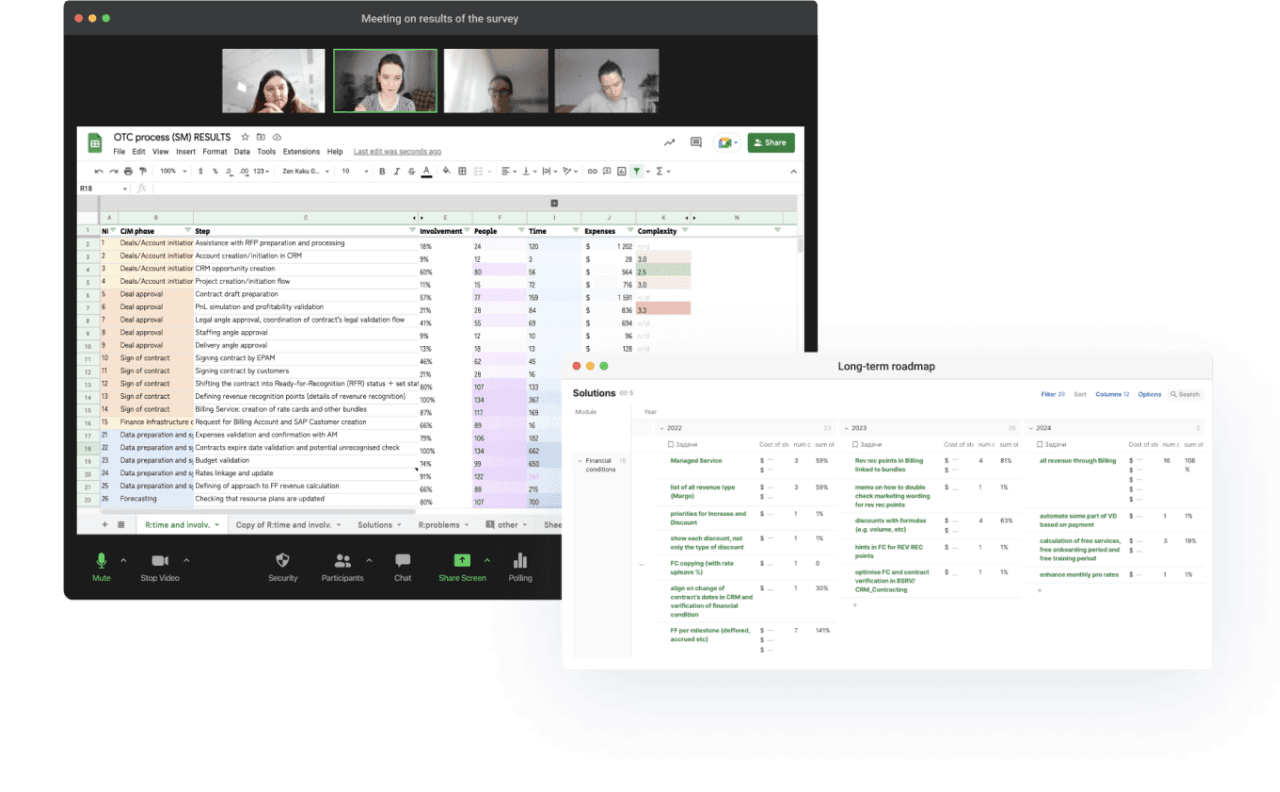
I conducted a series of workshops in which stakeholders and the product owner collaborated with me to pinpoint opportunities for various systems.
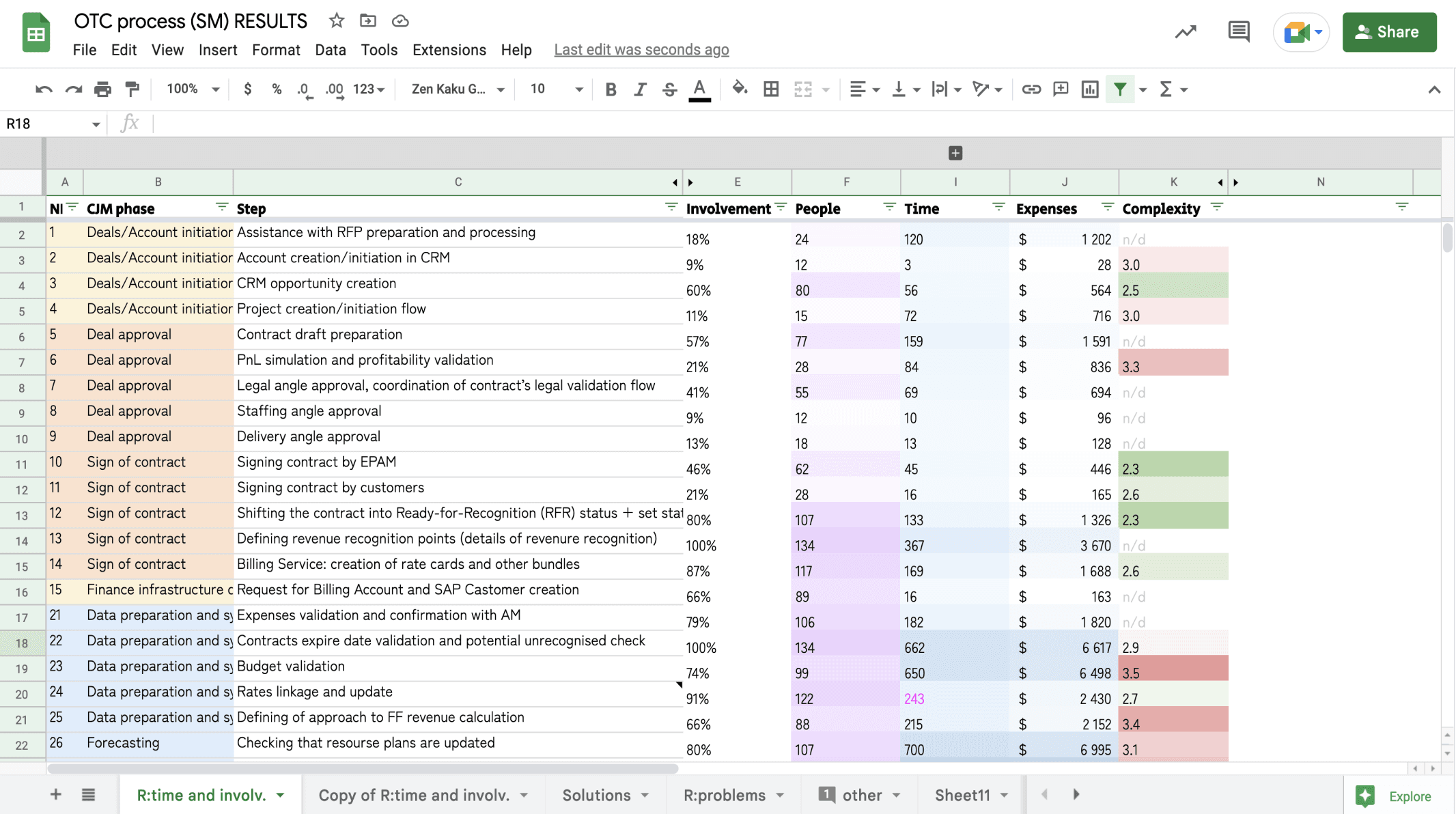
We based our approach on the existing list of problems for all the steps of the Customer Journey Map, taking into account the frequency of these issues.
Meeting on results of the survey



...
...
...
...
...
...
...
...
...
...
...
...
...
...
...
...
...
...
...
...
...
...
...
...
...
...
...
...
...
Long-term roadmap


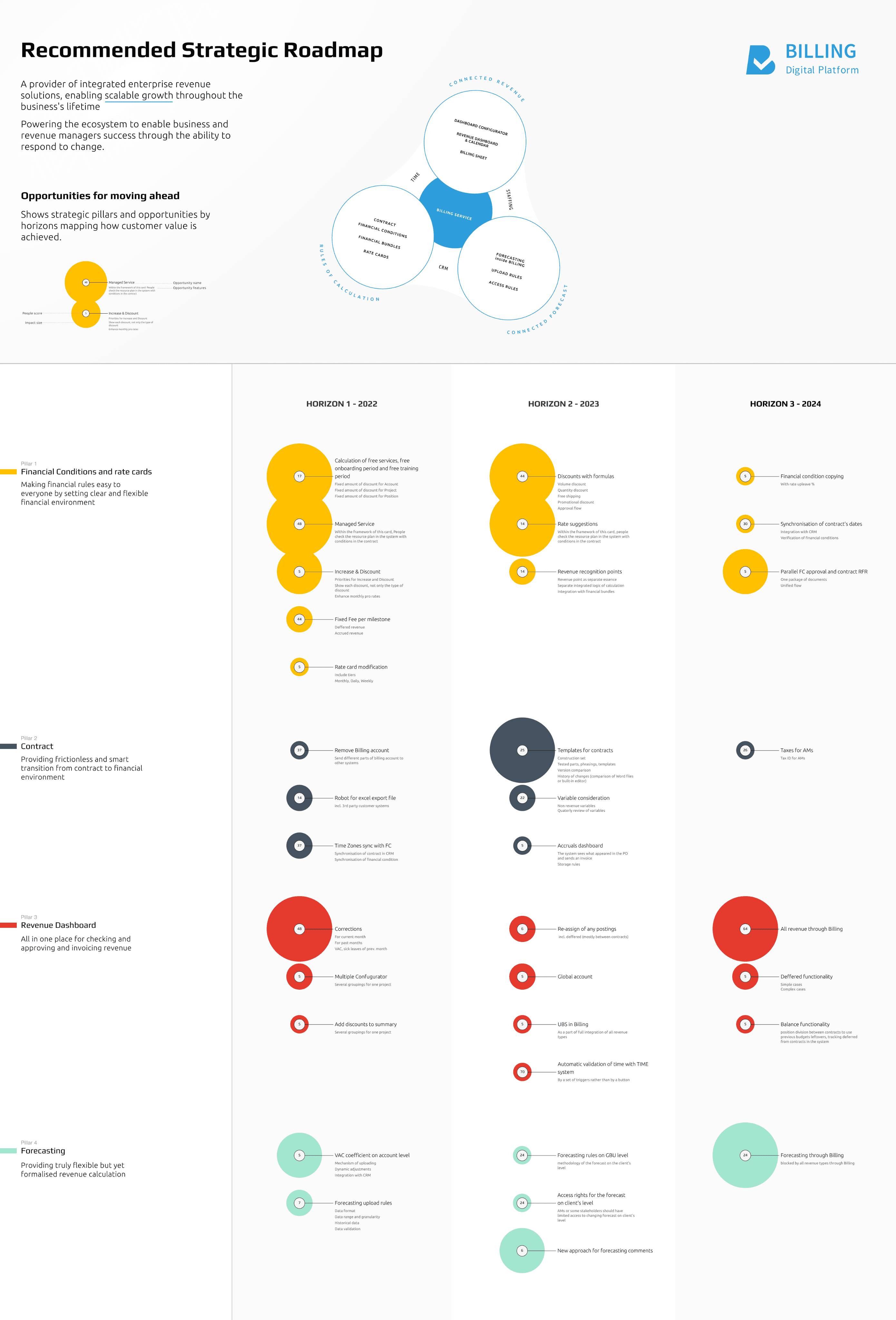
“Smart” roadmap
We categorised the opportunities into pillars and allocated them across different horizons.
Subsequently, I ensured that all action items were incorporated into the backlog of all products related to the order-to-cash process.
I didn’t expect such a big time on the revenue calculation step... We need to find out causes of it!


Vera Samasionak
Senior Director, OTC Business Partnering
Research results
Comprehensive data-driven description of process
Quantitative and qualitative data for making decisions on both big and small functionalities
Backlog of “Billing service” product is prioritised
basing on both research results and vision of product owner and stakeholders
Action items for more than 420 problems
including change of the process and improvements of various products across financial portfolio
CJM is being used for wider purposes
to onboard new revenue specialists and by product owners and business analysts of related products
Order-to-cash discovery
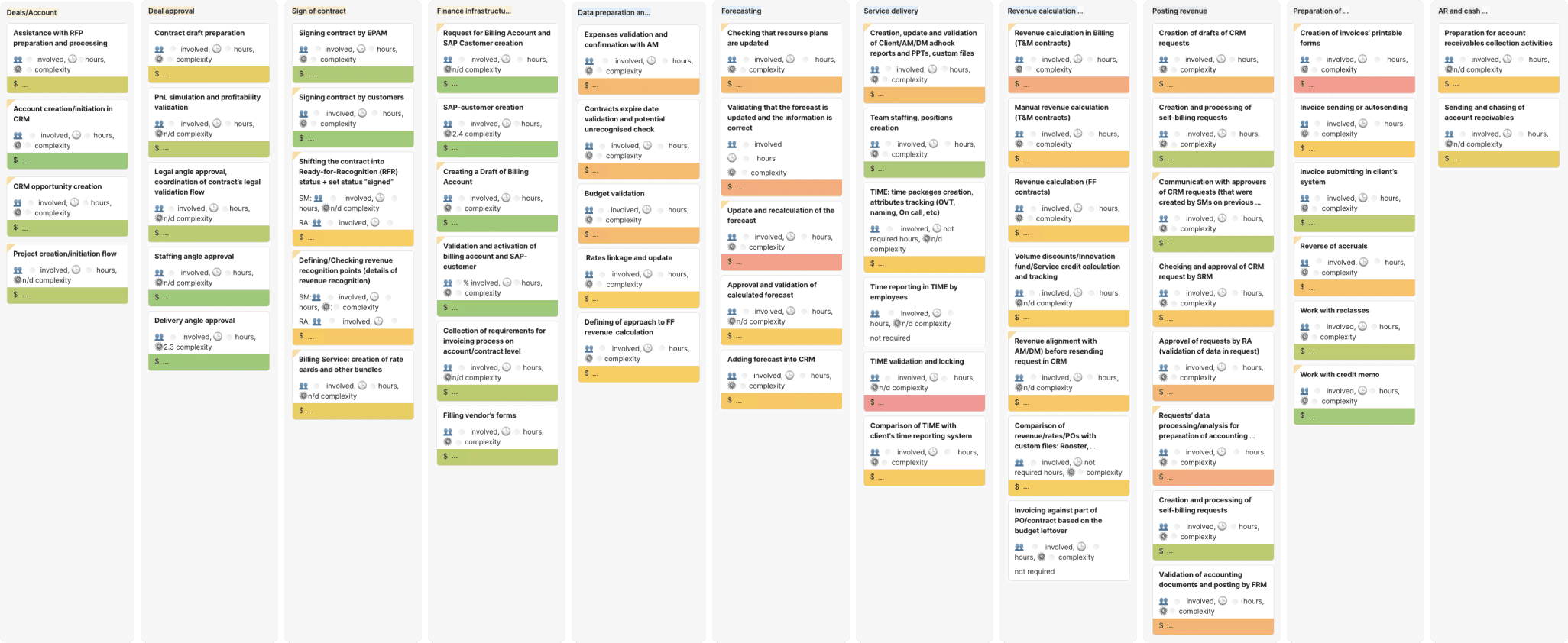
The order-to-cash process encompasses various systems and roles involved in deal approval, contract and financial infrastructure preparation, revenue calculation, forecasting, posting, and invoicing.
I engaged diverse stakeholders, leveraging their varying levels of influence, for data gathering, analysis, and opportunity generation. This research served as a shared user-centered foundation, benefiting multiple financial portfolio teams.
Coda
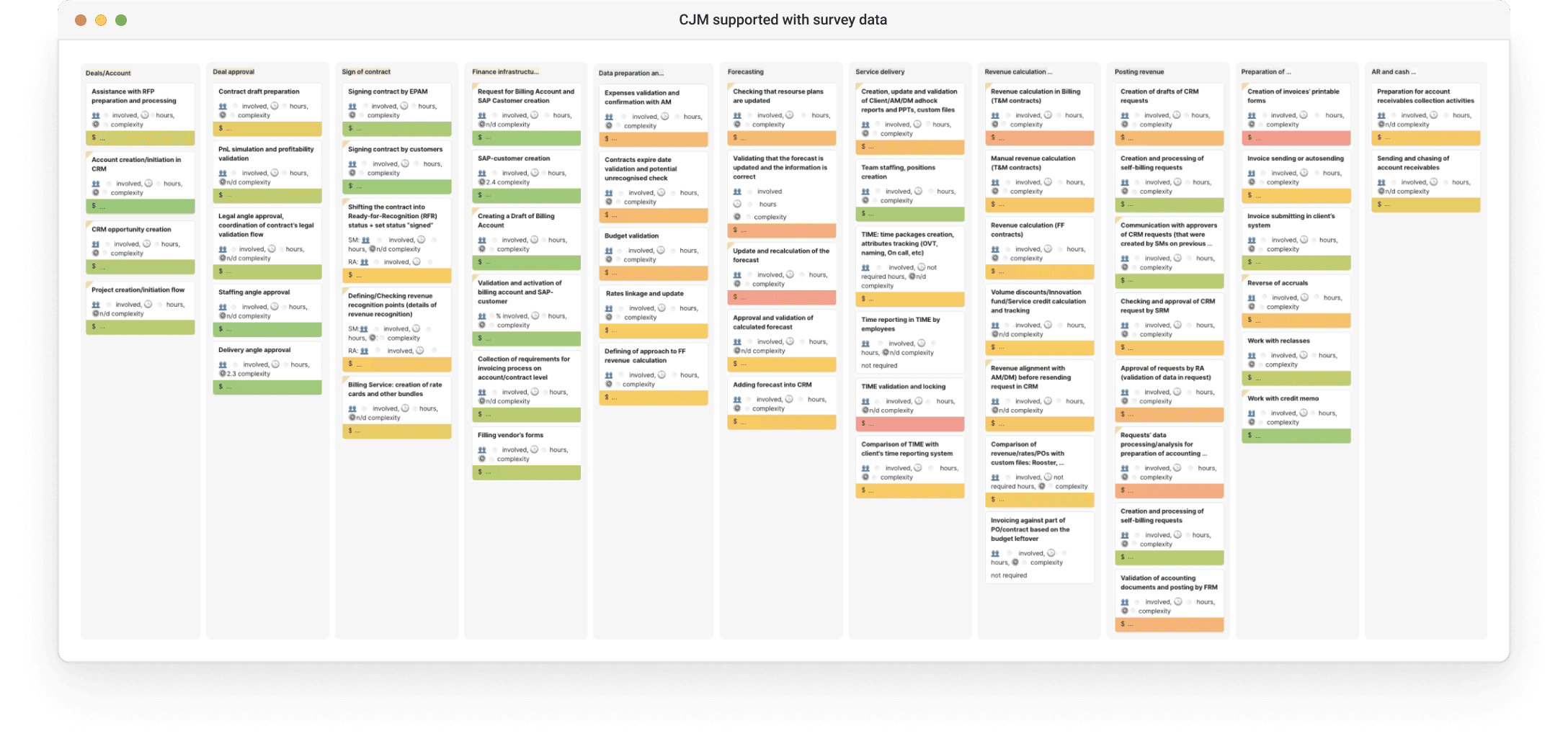
CJM supported with survey data
180
survey respondents
260
survey questions
400
problems
100
solutions
About the project
The order-to-cash process struggled to match the company's rapid growth. Comprehensive optimisation was the only viable solution.
The challenge lay in establishing a methodology for assessing the steps of the Customer Journey Map and guaranteeing the most pertinent research outcomes.
I was invited to the project to build bird-eye view of process, add the voice of user into decision-making process and provide stakeholders with quantitative data for backlogs’ prioritisation

Daria Kriuchkova
Experience Consultant
Product Owner

Directors


Revenue Managers



Analysts and Designers

This stage is the longest, most
monotonous and stressful

I hate manual adjustments of the revenue

Some of us are involved into
forecast calculation
Interviews
I conducted interviews with four accountants and four revenue specialists, each possessing a high-level understanding of the process and the capability to delve into specific details.
Although the primary target of the interviews was to compile steps, I also focused on identifying the most painful problems.
>3
years in the company
>2
years in leader’s role
Putting the puzzle together
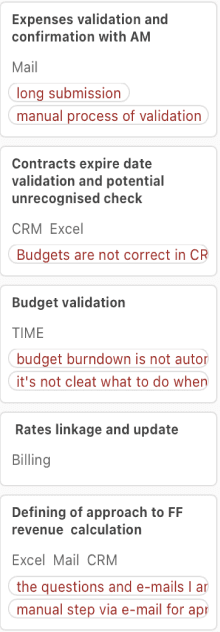
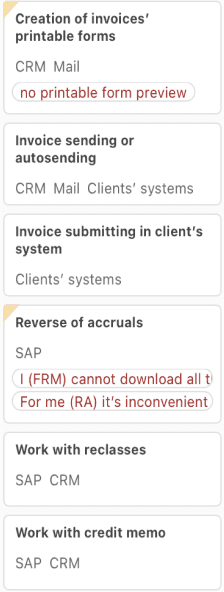
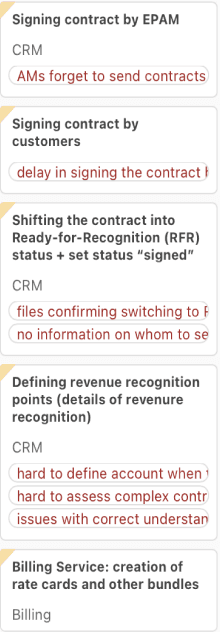
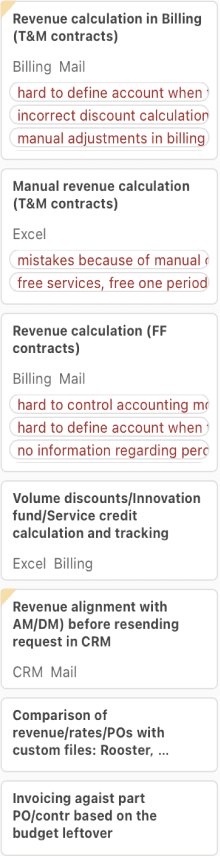
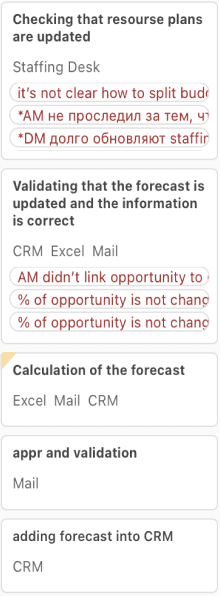
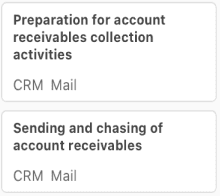
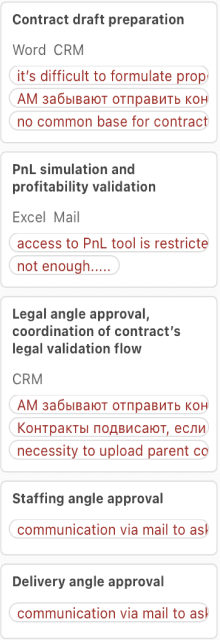
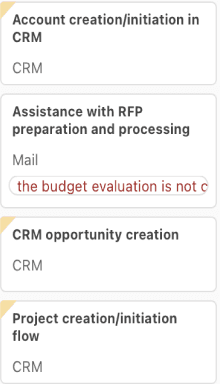
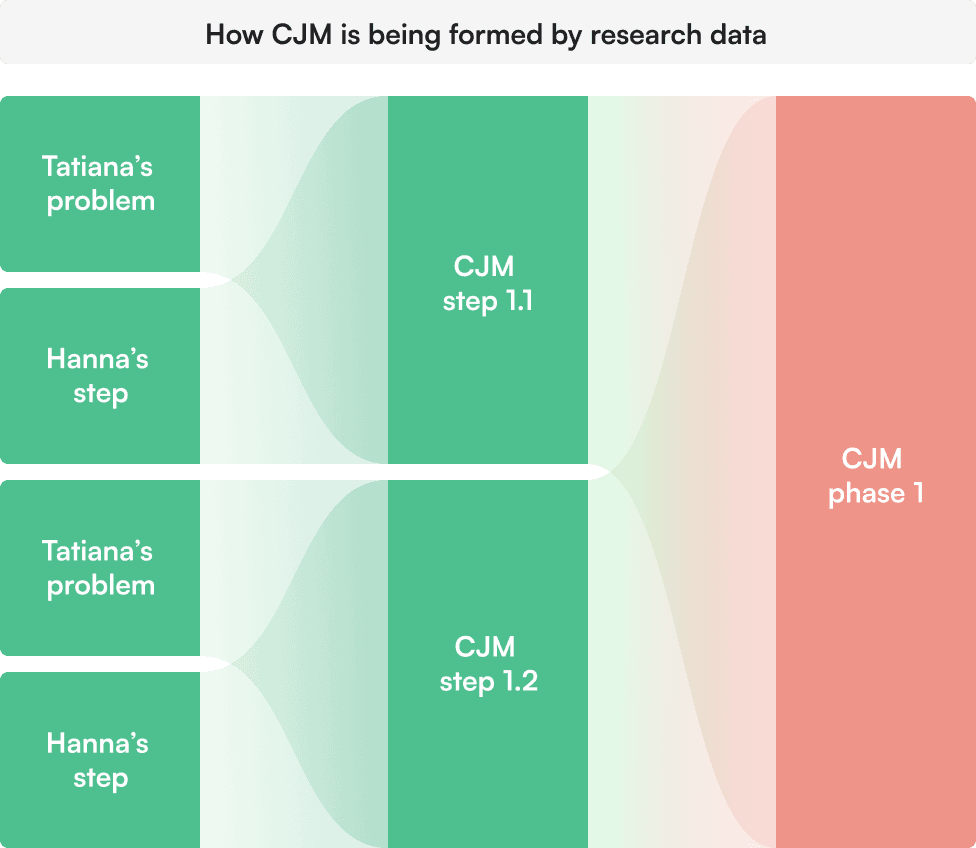
The transcription results for each respondent culminated in a nested CJM: phases encompassing steps, which in turn contained problems. Then I combined CJMs of all respondents into a single model.
Puzzles of process from respondents with different roles and seniority level were perfectly complementing each other.
Tatiana’s
problem
CJM
step 1.1
CJM
phase 1
CJM
step 1.2
Tatiana’s
problem
Hanna’s
step
Hanna’s
step
How CJM is being formed by research data
Collaboration to achieve more
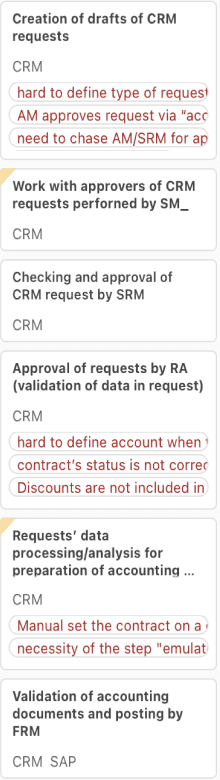
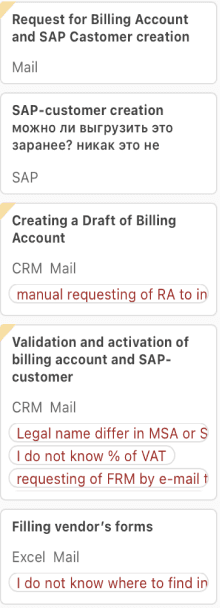
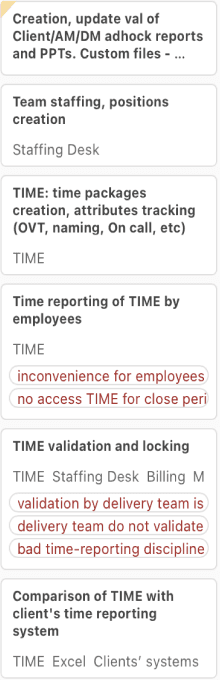
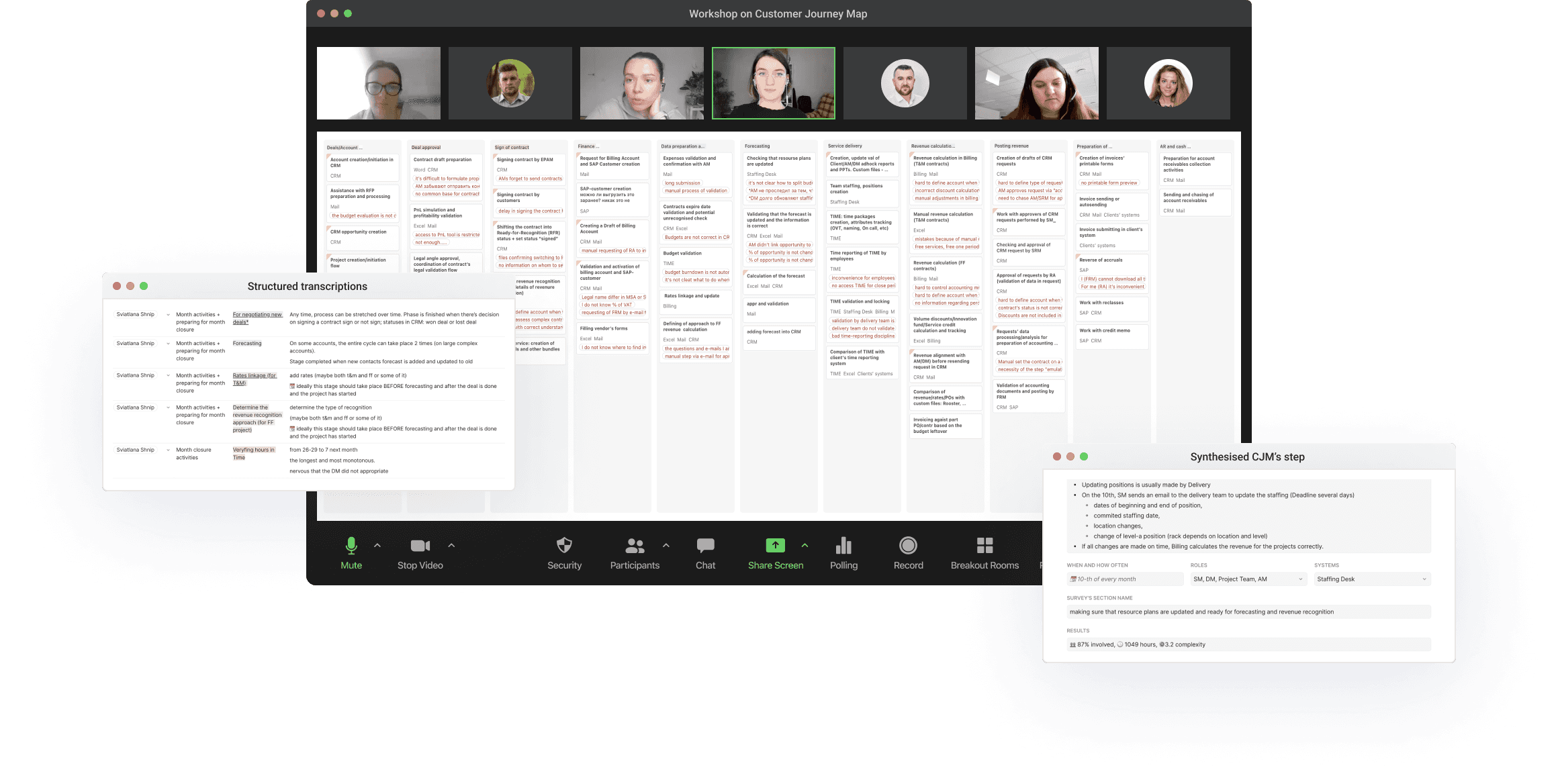
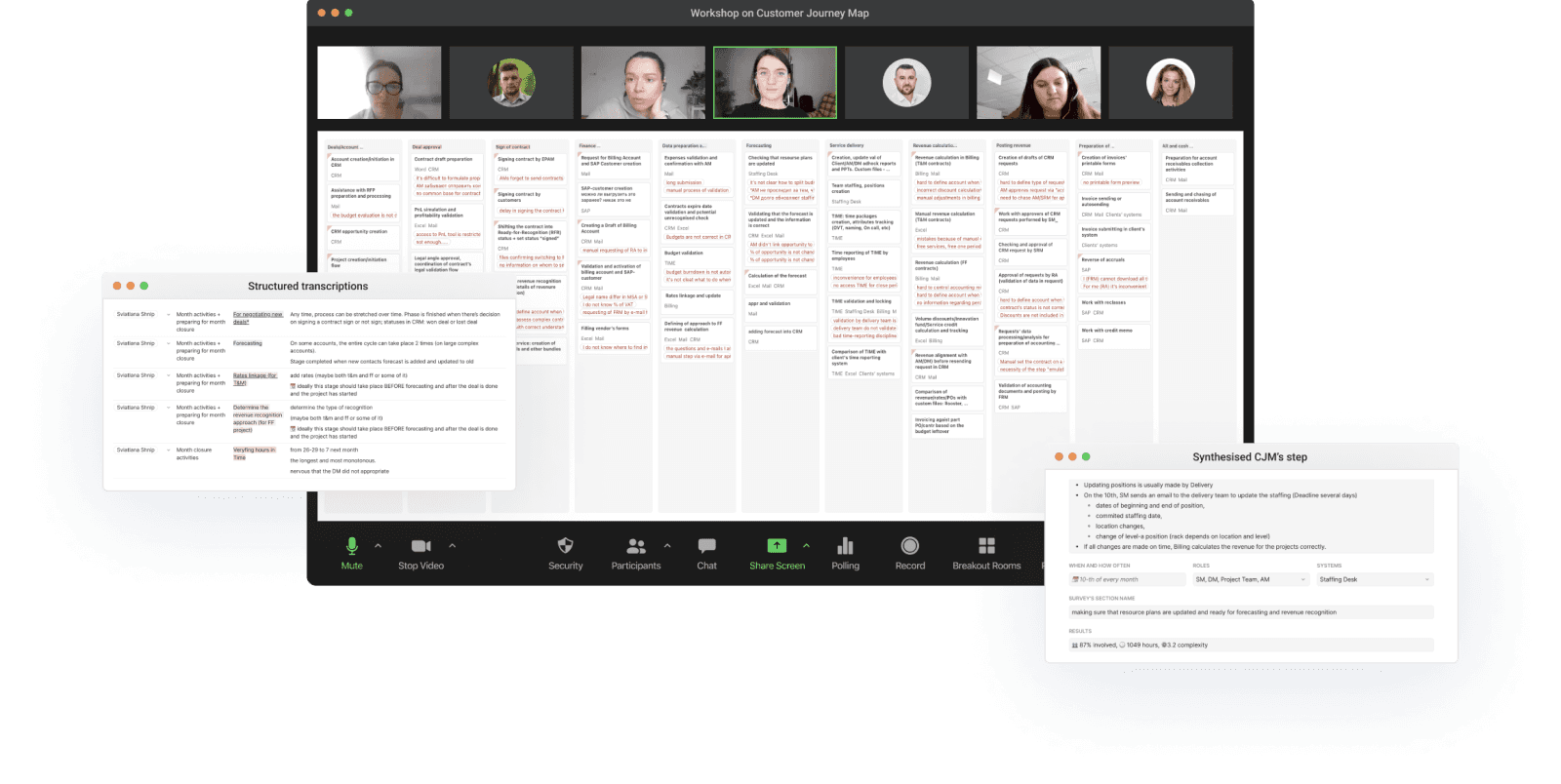
Given the inclusion of numerous interconnected systems, roles, and activities in the workflow, I engaged a multidisciplinary team to collaborate on the final Customer Journey Map (CJM). Together, we ensured the steps were comprehensive and identified additional problems.
Workshop on Customer Journey Map











Structured transcriptions
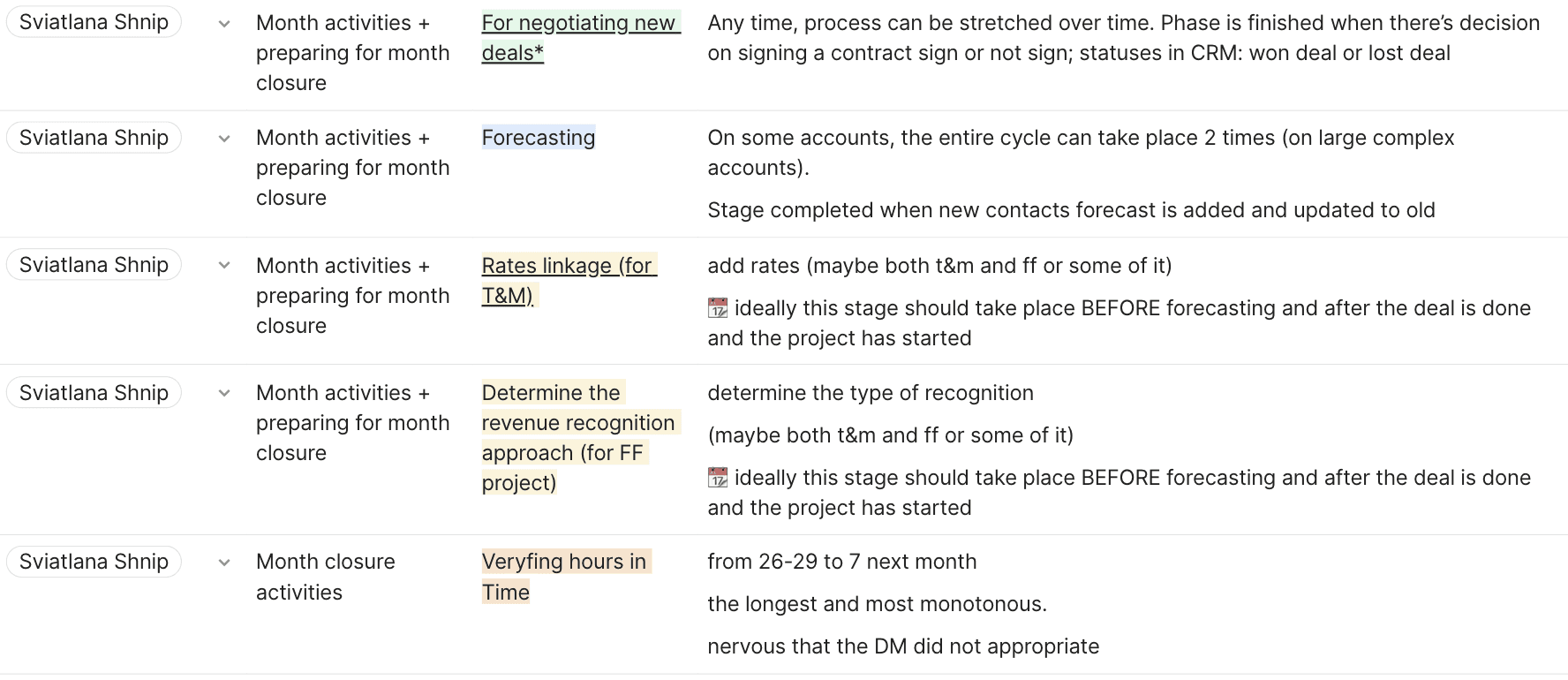





Synthesised CJM’s step
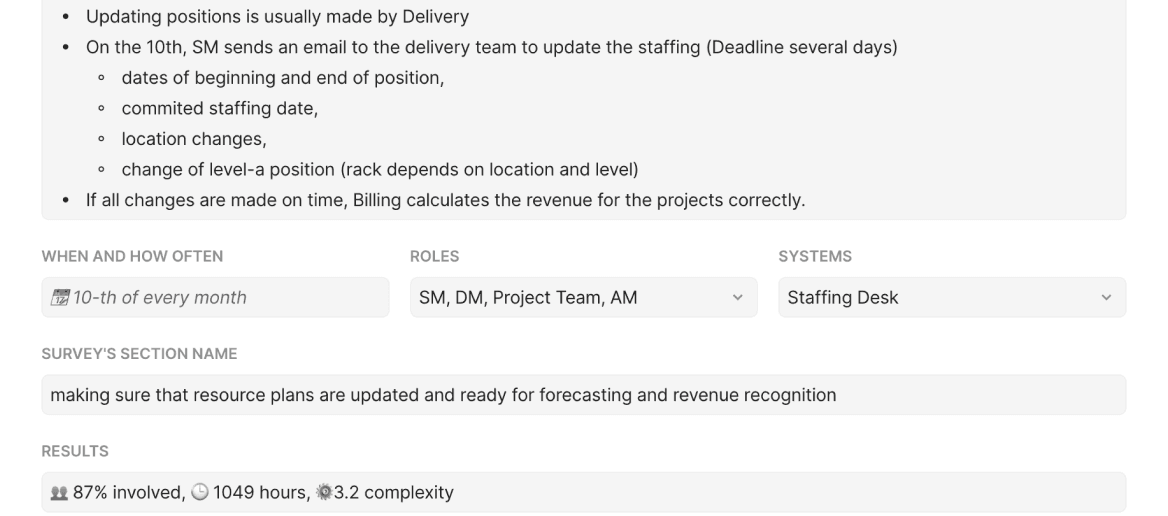
Survey that brings value
Validating that the forecast is updated and the information is correct
$10,493
967 hours
🕒
2.8 complexity
⚙️
72% involed
👥
Following extensive deliberation and consultations with senior colleagues, I selected the metrics that informed the survey questions.
I ensured the survey responses would be as realistic as possible by testing questions with stakeholders and a testing group, locating supporting statistics, and gathering all respondents in one room to maintain their full attention
on the survey questions.
This is a very important exercise!

Aliaksandra Nestsiarovich
Director, OTC Business Partnering

Other cases
PayRoll App Discovery
I led a team through the discovery phase, analyzing journeys in 25 countries. By automating data analysis, I achieved a 30% reduction in time.

Interviews
150
Analysed datapoints
3200
Expenses App Strategy Shift
I led a research team that produced CJMs and personas, informing a new concept, and then coordinated focus groups and a quantitative survey to validate it, driving adoption and saving time and resources versus the original approach.

Team size
4
Months saved
4
Order-to-cash discovery
The order-to-cash process encompasses various systems and roles involved in deal approval, contract and financial infrastructure preparation, revenue calculation, forecasting, posting, and invoicing.
I engaged diverse stakeholders, leveraging their varying levels of influence, for data gathering, analysis, and opportunity generation. This research served as a shared user-centered foundation, benefiting multiple financial portfolio teams.
180
survey respondents
260
survey questions
400
problems
100
solutions
About the project
The order-to-cash process struggled to match the company's rapid growth. Comprehensive optimisation was the only viable solution.
The challenge lay in establishing a methodology for assessing the steps of the Customer Journey Map and guaranteeing the most pertinent research outcomes.
I was invited to the project to build bird-eye view of process, add the voice of user into decision-making process and provide stakeholders with quantitative data for backlogs’ prioritisation
Daria Kriuchkova
Experience Consultant
Product Owner
Directors
Revenue Managers
Analysts and Designers
Interviews
I conducted interviews with four accountants and four revenue specialists, each possessing a high-level understanding of the process and the capability to delve into specific details.
Although the primary target of the interviews was to compile steps, I also focused on identifying the most painful problems.
>3
years in the company
>2
years in leader’s role
This stage is the longest, most monotonous and stressful
I hate manual adjustments of the revenue

Some of us are involved into forecast calculation
Putting the puzzle together
The transcription results for each respondent culminated in a nested CJM: phases encompassing steps, which in turn contained problems. Then I combined CJMs of all respondents into a single model.
Puzzles of process from respondents with different roles and seniority level were perfectly complementing each other.
Tatiana’s
problem
CJM
step 1.1
CJM
phase 1
CJM
step 1.2
Tatiana’s
problem
Hanna’s
step
Hanna’s
step
How CJM is being formed by research data
Collaboration to
achieve more
Given the inclusion of numerous interconnected systems, roles, and activities in the workflow, I engaged a multidisciplinary team to collaborate on the final Customer Journey Map (CJM). Together, we ensured the steps were comprehensive and identified additional problems.
Series of co-creation
I conducted a series of workshops in which stakeholders and the product owner collaborated with me to pinpoint opportunities for various systems. We based our approach on the existing list of problems for all the steps of the Customer Journey Map, taking into account the frequency of these issues.
“Smart” roadmap
We categorised the opportunities into pillars and allocated them across different horizons.
Subsequently, I ensured that all action items were incorporated into the backlog of all products related to the order-to-cash process.
I didn’t expect such a big time on the revenue calculation step... We need to find out causes of it!

Vera Samasionak
Senior Director, OTC Business Partnering
Research results
Comprehensive data-driven description of process
Quantitative and qualitative data for making decisions on both big and small functionalities
Backlog of “Billing service” product is prioritised
basing on both research results and vision of product owner and stakeholders
Action items for more than 420 problems
including change of the process and improvements of various products across financial portfolio
CJM is being used for wider purposes
to onboard new revenue specialists and by product owners and business analysts of related products
Other cases
PayRoll App Discovery
I led a team through the discovery phase, analyzing journeys in 25 countries. By automating data analysis, I achieved a 30% reduction in time.
Interviews
150
Analysed datapoints
3200
PayRoll App Discovery
I led a team through the discovery phase, analyzing journeys in 25 countries. By automating data analysis, I achieved a 30% reduction in time.
Interviews
150
Analysed datapoints
3200
Expenses App Strategy Shift
I led a research team that produced CJMs and personas, informing a new concept, and then coordinated focus groups and a quantitative survey to validate it, driving adoption and saving time and resources versus the original approach.
Team size
4
Months saved
4
Expenses App Strategy Shift
I led a research team that produced CJMs and personas, informing a new concept, and then coordinated focus groups and a quantitative survey to validate it, driving adoption and saving time and resources versus the original approach.
Team size
4
Months saved
4

Order-to-cash
discovery
The order-to-cash process encompasses various systems and roles involved in deal approval, contract and financial infrastructure preparation, revenue calculation, forecasting, posting, and invoicing.
I engaged diverse stakeholders, leveraging their varying levels of influence, for data gathering, analysis, and opportunity generation. This research served as a shared user-centered foundation, benefiting multiple financial portfolio teams.
180
survey respondents
260
survey questions
400
problems
100
solutions
About the project
The order-to-cash process struggled to match the company's rapid growth. Comprehensive optimisation was the only viable solution.
The challenge lay in establishing a methodology for assessing the steps of the Customer Journey Map and guaranteeing the most pertinent research outcomes.
I was invited to the project to build bird-eye view of process, add the voice of user into decision-making process and provide stakeholders with quantitative data for backlogs’ prioritisation
Daria Kriuchkova
Experience Consultant
Directors
Product Owner
Revenue Managers
Analysts and Designers
Interviews
I conducted interviews with four accountants and four revenue specialists, each possessing a high-level understanding of the process and the capability to delve into specific details.
Although the primary target of the interviews was to compile steps, I also focused on identifying the most painful problems.
>3
years in the company
>2
years in leader’s role
This stage is the longest, most
monotonous and stressful
Some of us are involved into
forecast calculation
I hate manual adjustments
of the revenue
Putting the puzzle together
The transcription results for each respondent culminated in a nested CJM: phases encompassing steps, which in turn contained problems. Then I combined CJMs of all respondents into a single model.
Puzzles of process from respondents with different roles and seniority level were perfectly complementing each other.
Collaboration
to achieve more
Given the inclusion of numerous interconnected systems, roles, and activities in the workflow, I engaged a multidisciplinary team to collaborate on the final Customer Journey Map (CJM). Together, we ensured the steps were comprehensive and identified additional problems.
Series
of co-creation
I conducted a series of workshops in which stakeholders and the product owner collaborated with me to pinpoint opportunities for various systems. We based our approach on the existing list of problems for all the steps of the Customer Journey Map, taking into account the frequency of these issues.
“Smart” roadmap
We categorised the opportunities into pillars and allocated them across different horizons.
Subsequently, I ensured that all action items were incorporated into the backlog of all products related to the order-to-cash process.
I didn’t expect such a big time on the revenue calculation step... We need to find out causes of it!
Vera Samasionak
Senior Director,
OTC Business Partnering
Research results
Comprehensive data-driven description of process
Quantitative and qualitative data for making decisions on both big and small functionalities
Backlog of “Billing service” product is prioritised
basing on both research results and vision of product owner and stakeholders
Action items for more than 420 problems
including change of the process and improvements of various products across financial portfolio
CJM is being used for wider purposes
to onboard new revenue specialists and by product owners and business analysts of related products
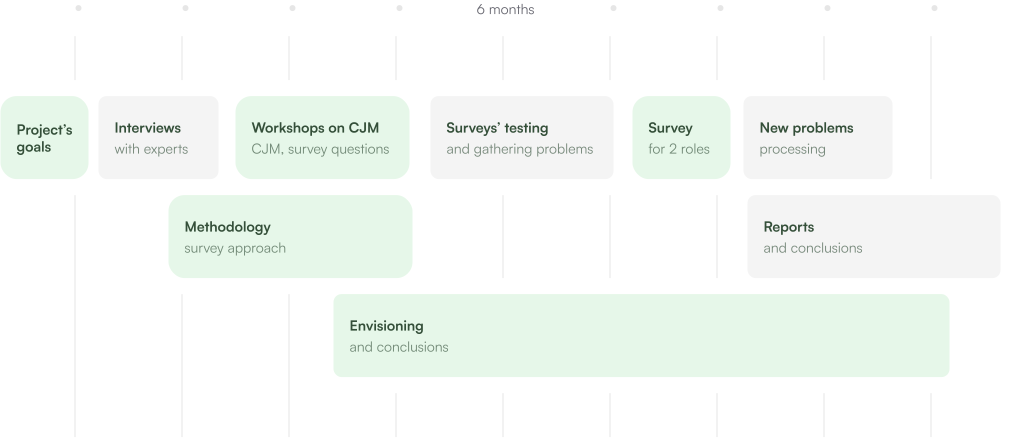
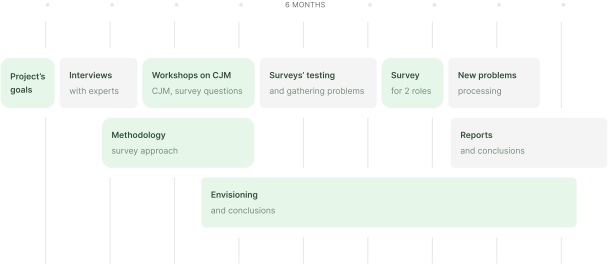
Activities
Project’s goals
Interviews with experts
Workshops on CJM survey questions
Surveys’ testing and gathering problems
Survey for 2 roles
New problems processing
Methodology survey approach
Reports and conclusions
Envisioning and conclusions
Other cases
PayRoll App Discovery
I led a team through the discovery phase, analyzing journeys in 25 countries. By automating data analysis, I achieved a 30% reduction in time.
Interviews
150
Analysed datapoints
3200
PayRoll App Discovery
I led a team through the discovery phase, analyzing journeys in 25 countries. By automating data analysis, I achieved a 30% reduction in time.
Interviews
150
Analysed datapoints
3200
Expenses App Strategy Shift
I led a research team that produced CJMs and personas, informing a new concept, and then coordinated focus groups and a quantitative survey to validate it, driving adoption and saving time and resources versus the original approach.
Lead team size
4
Months saved
4
Expenses App Strategy Shift
I led a research team that produced CJMs and personas, informing a new concept, and then coordinated focus groups and a quantitative survey to validate it, driving adoption and saving time and resources versus the original approach.
Lead team size
4
Months saved
4